
Searching Lincoln County Civil Dockets
There is no official public Lincoln trial-court viewer. A useful search begins by classifying the matter, then contacting the clerk who maintains that docket. The Circuit Court Clerk keeps Circuit and General Sessions civil papers and indexes. The Clerk & Master handles Chancery and probate matters. A request sent to the wrong office can create a false no-record result.
Provide the local case number when known. Otherwise give the exact party, business, or estate name, a bounded date range, and the case type. Counter, telephone, and mailed requests remain core channels. Tennessee records guidance also permits inspection requests by phone, fax, mail, email, or in person, subject to the custodian's procedure. Ask for inspection, a plain copy, or a certified copy and request a cost estimate.
- Classify the case as Circuit, General Sessions, Chancery, probate, or city court.
- Contact the correct Lincoln clerk with the case number or a precise name and date range.
- Name the document, such as a docket sheet, complaint, order, or judgment.
- Ask whether the record is public, sealed, restricted, or available with redactions.
- If an appeal exists, use its trial number to cross-reference the local file.
Lincoln Civil Docket Split
Lincoln County divides civil custody between two offices at the same courthouse address. Lisa Simmons, Circuit Court Clerk, is in Room 203 at 112 Main Avenue South, Fayetteville, Tennessee 37334, telephone (931) 433-2334. Rebecca N. Bartlett Carpenter, Clerk & Master, is in Room B-109 at that address, telephone (931) 433-1482.
| Office | Lincoln civil work | Useful request |
|---|---|---|
| Circuit Court Clerk | Circuit civil and General Sessions civil indexes and papers | Case number, party or business, date range, document |
| Clerk & Master | Chancery, equity, domestic relations, property, and probate | Case or estate name, subject, date range, order |
| City-court clerk | Limited municipal ordinance matters | Issuing city and citation or case details |
The County Clerk is a separate office. It maintains marriage licenses, vehicle and title records, business licenses, and county-government records rather than the ordinary Lincoln County civil docket. Choose the custodian from the court and subject, not from the similar office title.
Inside a Lincoln County Civil Docket
A civil docket records the procedural path of a dispute or proceeding. It can show the caption, party roles, filing date, pleadings, service activity, motions, hearing settings, orders, judgment, and appeal. An official appellate opinion inspected in the research displayed a Lincoln Circuit trial number in a 23-CV-132-type format. Retain punctuation and prefixes, but do not assume that one sample governs all courts or historical files.
| Case Number | The most precise local locator; include the year and case-type marks. |
|---|---|
| Case Style | Party, entity, or estate caption and each listed role. |
| Filings | Complaint, petition, answer, return of service, motion, or exhibit entry. |
| Settings | Hearing date, court, judge, setting type, and reset when recorded. |
| Orders | Entered rulings, final or partial judgment, dismissal, or other disposition. |
A docket entry is not always the document itself. Ask for the signed order to learn its scope. A filed complaint does not prove the claim succeeded, and an appeal entry does not prove reversal.
Lincoln E-Filing Is Not Search
Tennessee Rule of Civil Procedure 5B permits electronic filing under local rules. The state Judicial Annual Report lists Lincoln Circuit and Lincoln Chancery as applied e-filing courts. That finding concerns how authorized users file and serve papers. It does not establish a free public docket viewer.
The official Rule 5B source is shown below.
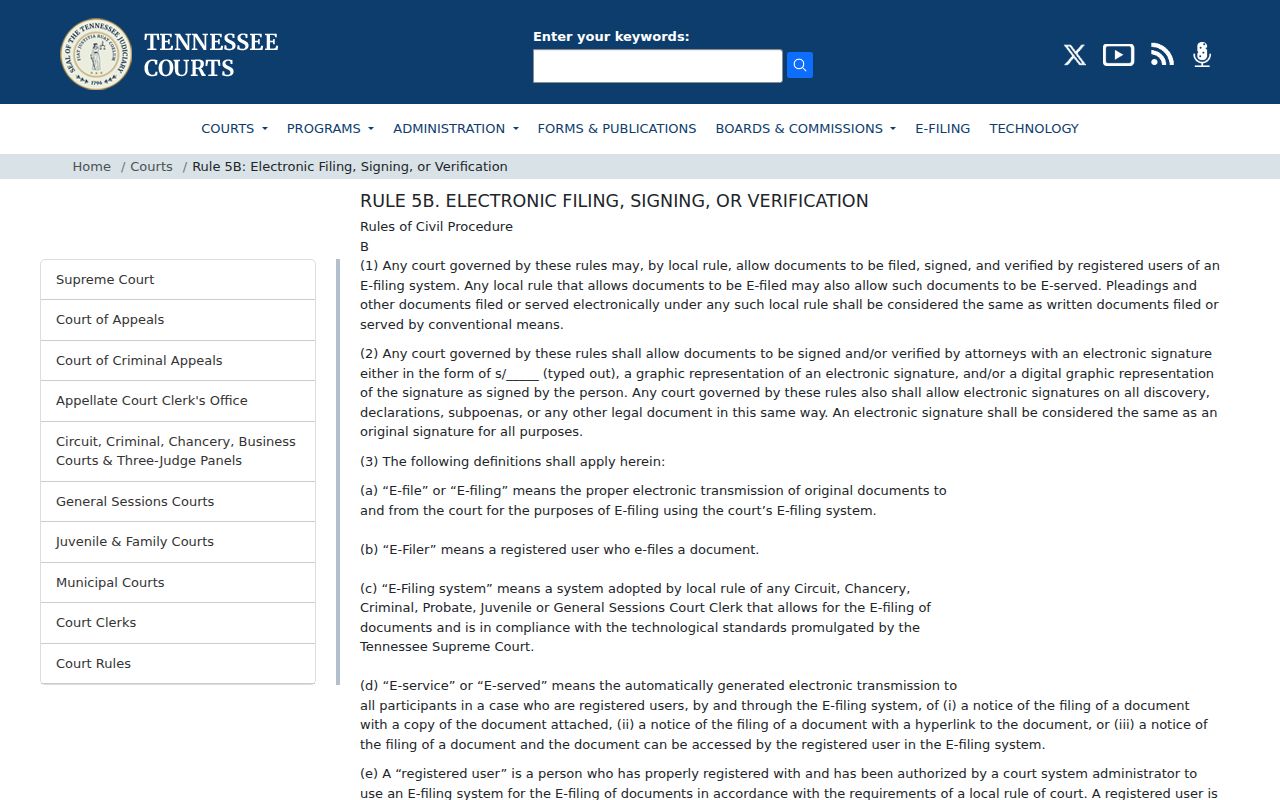
The source supports asking each clerk about current filing mechanics. Public inspection still follows the clerk and access rules. A login used to submit a pleading should not be described as a public name-search system.
Civil Case Types on the Docket
Circuit is Lincoln County's general-jurisdiction civil forum and receives some appeals from limited courts. Chancery has a broad local subject list. The Clerk & Master's official description includes adoption, divorce, orders of protection, name change, damages, administrative appeal, specific performance, will contests, debt, partition, property tax, and real-estate matters. Probate covers estates, small-estate administration, guardianships, and conservatorships.
- Circuit contract, debt, tort, damages, and other general civil matters
- General Sessions civil or small-claim matters and later appeals
- Chancery equity, real estate, partition, and specific-performance cases
- Domestic-relations, protection-order, adoption, and name-change proceedings
- Probate estates, guardianships, conservatorships, and related administration
These categories route a request, but they do not decide public access. Adoption, protected-person, and some family material may be confidential or redacted. Ask for the access status without seeking private details.
Probate Leads Lincoln Chancery
The official AOC filings report for July 2024 through June 2025 lists 407 Lincoln Chancery filings and 369 dispositions. Probate and trust matters were the largest filing category at 163. Residential parenting and child support followed at 83, and divorce without minor children accounted for 45.
The same report lists 206 Circuit civil filings and 215 dispositions for Lincoln County. These administrative counts are not an open-case list. They cannot identify a party, show whether one estate remains open, or replace a clerk's docket search.
Civil Docket Settings and Hearings
A hearing date marks scheduled court activity, not the outcome. A Lincoln County civil docket may show the court, date, time, judge, setting type, and later continuance. A scheduling order can set deadlines and hearings, while another entry may reset them. Confirm the current setting with the clerk because a printed notice or older entry may no longer control.
When calling, state the court and local case number. Ask whether the entry is a motion hearing, status conference, trial, probate hearing, or another setting. Then ask if a later order continued or canceled it. The full county scheduling workflow appears in the Lincoln County court dates resource.
Note: A setting is not a disposition, and a judgment date does not prove all later issues are closed.
Lincoln Civil Status Language
Civil terms describe steps with different effects. Read the dated entry and the filed order together. The docket shorthand alone may omit conditions, affected claims, or later action.
- Filed
- A paper was accepted or entered; success has not been decided.
- Served
- Required notice or process was delivered or a return was recorded.
- Motion pending
- A request awaits a ruling.
- Default
- A procedural posture after no response; relief depends on the order.
- Remanded
- An appellate court sent the matter back for further proceedings.
Dismissal with prejudice and dismissal without prejudice are not interchangeable. A settlement entry may not disclose all terms. An agreed order is still an official order once entered. Request the exact document when those distinctions affect the question.
Lincoln Civil Appeal Cross-Reference
Tennessee Public Case History can locate Supreme Court, Court of Appeals, and Court of Criminal Appeals records. It is not a local trial search. Search an appeal by full appellate number, style, party, or business. An opened detail may reveal the originating Lincoln court and trial number, along with briefs, orders, opinions, milestones, and disposition.
| Search layer | What it can establish | What it cannot replace |
|---|---|---|
| Public Case History | Appellate case, trial reference, appellate events and linked PDFs | Complete Lincoln trial file |
| Circuit Clerk | Circuit and General Sessions civil index, docket, and documents | Chancery or probate custody |
| Clerk & Master | Chancery and probate docket and documents | Circuit civil custody |
A blank appellate search does not show that the local civil matter is absent. Most trial matters do not reach that portal. Use a known trial number from an appeal as a bridge, then return to the correct Lincoln clerk.
Civil Docket Access Rules
Tennessee Supreme Court Rule 34 provides the public-access starting point, subject to law, rule, and court order. Civil records are generally presumed open, but protected information, internal judicial material, sealed documents, and confidential proceedings are not ordinary public content. Tennessee Civil Rule 1A requires a specific serious interest and no less restrictive means before sealing under its standard.
Family and protected-person matters call for care. Adoption, guardianship, conservatorship, dependency, and juvenile-related records may have special restrictions. Certification does not override access limits. The clerk may provide a redacted public copy or explain that no public release is permitted.
Request precisely: Name the court, case, document, date, and copy type. If access is denied, ask for the legal basis and whether non-exempt parts can be released.