
Lincoln County Appellate Record Layer
Appeals live in a different layer. Tennessee Public Case History covers the Supreme Court, the Court of Appeals, and the Court of Criminal Appeals, so it is the tool to use when an appeal is known or suspected. An appellate entry can point back to the originating Lincoln County court. It may show the trial number. That is useful. Just remember the system does not reach every local case, so take the cross-reference to the Circuit Clerk or Clerk & Master for the actual trial file.
Getting Lincoln County Court Records
Start with the right office. The Lincoln County Circuit Court Clerk keeps Circuit, Criminal, General Sessions, and Juvenile files and their indexes. The Clerk & Master holds Chancery and probate. Lincoln County offers no online search form or scan archive for trial records, and Public Case History handles appeals only. In practice, a Lincoln County court record request goes by phone or email. An in-person visit also works. So does a written request by mail or another method the clerk confirms.
Give the clerk something to work with. The court name, local case number, exact party or estate name, a bounded date range, and the document title all help. Ask whether the record is public. Ask whether you need inspection, a plain copy, an electronic copy, or certification. A vague ask for the whole case just slows things down.
- Classify the matter and choose the responsible Lincoln County clerk.
- Call or email first when the case number, file location, or access status is unclear.
- Request inspection in person or ask the clerk how to submit a copy request by email or mail.
- Approve the stated copy, certification, postage, transcript, or recording cost.
- Check the court, case number, document title, date, and seal upon receipt.
Three Lincoln County Record Rooms
Three offices share one Fayetteville address, and each does a different job. Knowing the room number can spare you a false no-record answer. Circuit, Criminal, General Sessions, and Juvenile matters start with the Circuit Clerk in Room 203. The Clerk & Master in Room B-109 keeps Chancery. That office also holds probate, divorce, adoption, estate, guardianship, conservatorship, and equity files. The County Clerk in Room 102 handles vehicle registration. That office also issues marriage licenses and business licenses. It keeps county legislative minutes. Those are county records rather than ordinary trial-court files.
Lincoln County Circuit Court Clerk
112 Main Avenue South, Room 203
Fayetteville, TN 37334
(931) 433-2334
info@lincolntncourts.com
Lincoln County Clerk & Master
112 Main Avenue South, Room B-109
Fayetteville, TN 37334
(931) 433-1482
rebecca.bartlett@tncourts.gov
The Tennessee court clerk directory offers another official way to confirm Lincoln County clerk listings. A quick call before you travel is wise for an archived file, a restricted matter, or a certified copy.
The directory lists Tennessee clerk offices by county, which helps place a Lincoln County court record request with the correct office.
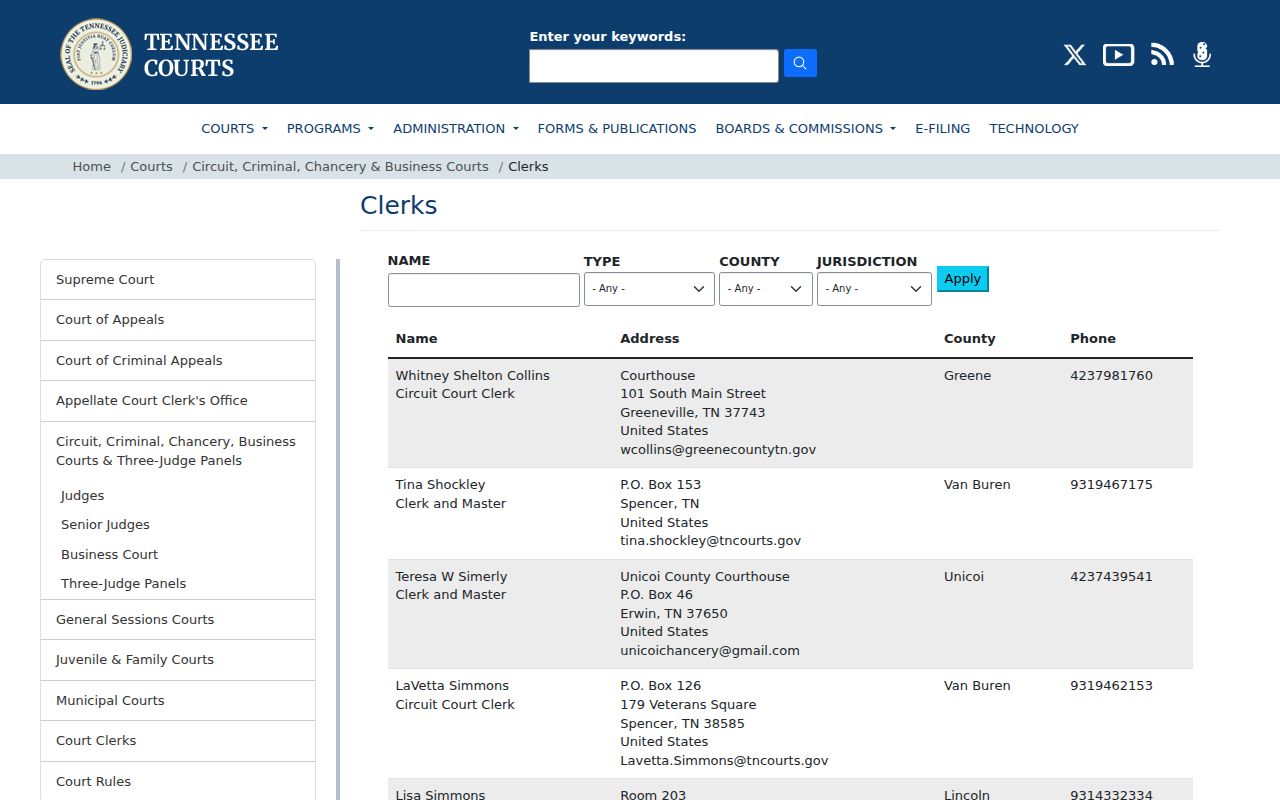
Treat the directory as a contact layer, not an online docket database. The local clerk still decides what can be inspected or copied.
Court Record Types
Lincoln County court records are not one product. Name the item you want, and the clerk can find it and price the request faster. A docket sheet is the chronological register of filings and events. It does not replace the filed papers. A judgment states a ruling. A motion, by contrast, records only a request that may still be waiting on a decision.
- Docket sheets, indexes, minute entries, and settings
- Complaints, petitions, answers, motions, and briefs
- Orders, judgments, decrees, and dispositions
- Probate, estate, guardianship, and conservatorship documents
- Transcripts, official recording duplicates, exhibits, and certified copies
Transcripts and exhibits may sit with other custodians or carry access limits of their own. A city ordinance or traffic judgment belongs to the relevant city-court clerk. Appellate opinions and orders appear in Tennessee Public Case History, but that result does not reproduce the full Lincoln County trial file.
Build a Narrow Lincoln Request
Details matter. The Tennessee Comptroller’s public-records guidance says a request should carry enough detail. That detail lets the custodian identify the material. You can ask to inspect records orally, by phone, fax, mail, email, or in person, though a clerk may require a written request or form before making copies. Lincoln County posts a policy link. The county offers no universal online request form, so plan on a direct request.
| Court and clerk | Circuit, Criminal, General Sessions, Juvenile, Chancery, Probate, or named city court |
|---|---|
| Identifier | Local case or docket number, with punctuation and any year prefix |
| Search terms | Exact party, business, or estate name and a bounded date range |
| Document | Docket sheet, pleading, order, judgment, transcript, exhibit, or recording |
| Output | Inspection, electronic copy, paper copy, or certified copy |
| Delivery | Pickup, mail, email, or another method the custodian offers |
If your request is large, offer to narrow it. When material is withheld, ask for the legal basis and whether non-exempt portions can be redacted and released. Tennessee guidance says records that are ready should be made available promptly. When that is not possible, the baseline still applies. It calls for access, a written denial, or a written time and cost estimate within seven business days.
Inside a Lincoln County Court Record
What is in the record depends on the court and the layer requested. Trial and appellate case numbers can differ. A state appeal may list the originating Lincoln trial court and its local number. Hand that number to the local clerk. Keep the exact wording, too, because filed, granted, and disposed describe different events.
| Case number | The court’s identifier; local formats may include a year and case-type letters such as 23-CV-132 |
|---|---|
| Case style | The caption naming parties or entities in procedural roles |
| Docket entries | Dated filings, settings, orders, continuances, and other events |
| Pleadings | Complaints, petitions, answers, motions, and responses |
| Orders and judgments | Signed court directives and rulings whose scope must be read |
| Appeal record | Technical record, transcript of evidence, exhibits, briefs, and appellate events when applicable |
The Tennessee judicial-system overview shows why court level matters to the search.
A higher-court entry can flag an appeal, but the originating clerk remains the source for the underlying Lincoln County court record.
Lincoln County Certified Record Routing
A certified copy is only as good as your request. Certification verifies the clerk's copy. It grants no new access. It cannot rescue a vague ask, either. So name the paper. That might be a certified judgment, certified order, certified docket sheet, or a particular probate document. Give the court, case number, document date, number of copies, and your delivery choice. Tennessee Evidence Rule 902 explains when certified public records prove themselves. The receiving court or agency may still impose added requirements.
Where you go depends on the court. Circuit and General Sessions certifications start in Room 203. Chancery and probate work begins in Room B-109. City judgments stay with the issuing city court. Appellate documents belong to the appellate clerk, or you can turn to Public Case History. Even a certified public copy may arrive with redactions.
Note: Before ordering multiple copies, ask the recipient which seal or certificate it actually requires.
Fees and Certified Copies
Lincoln County posts no certified-copy price on its official pages. Treat the statewide figures as reference points only. They are not a promise of the clerk's final bill. Ask for an estimate before copies are produced. It should cover certification, postage, unusual media, research, and delivery.
| Requested item | Verified amount or status |
|---|---|
| Ordinary black-and-white TPRA copy | $0.15 per page statewide example; confirm local policy |
| Ordinary color TPRA copy | $0.50 per page statewide example; confirm local policy |
| Certified Lincoln court copy | No local amount located; ask the responsible clerk |
| Transcript | No local amount located; ask about reporter rates and delivery |
| Official electronic recording duplicate | $50 per disc under Supreme Court Rule 26 |
A court record can stay open for inspection even when copies cost money. Tennessee citizenship information may be requested under a Tennessee Public Records Act request, and court-specific rules still govern judicial files.
Older Lincoln County Case Files
A missing web result does not mean a missing record. Lincoln County's official pages describe indexes and preserved case papers. Yet they expose no complete online archive. For an older case file, give the clerk name variants, an approximate filing or judgment period, and the court type. Include any prior number. Ask whether the index sits on paper, in an electronic system, in archive, or away from the counter.
E-filing does not change that limit. Tennessee Rule of Civil Procedure 5B permits electronic filing under local authority. The state annual report lists Lincoln Circuit and Chancery among applied e-filing courts. That workflow is not a free public viewer, though. Federal litigation runs on a different track entirely. Use PACER and the Middle District of Tennessee for federal cases rather than asking a Lincoln County clerk for a federal docket.
Sealed Records and Public Access
Tennessee Supreme Court Rule 34 supplies the starting point for public access. The rule also recognizes exceptions. They cover sealed material, internal judicial information, and records shielded by other law. Open to the public does not mean everything shows up in your copy. Identifiers, attachments, medical details, financial numbers, and protected addresses may be held back.
Civil court records are generally open. But Civil Procedure Rule 1A allows sealing once the required findings are met. Juvenile Rule 114 gives dependency and neglect records stricter treatment. Adoption and protected-person files may need special handling too. Certification never overrides those limits.
Request the public portion:
If one document or field is protected, ask the Lincoln County clerk whether the rest can be inspected or released with redactions.
The official Rule 34 page puts openness and its exceptions in one framework.
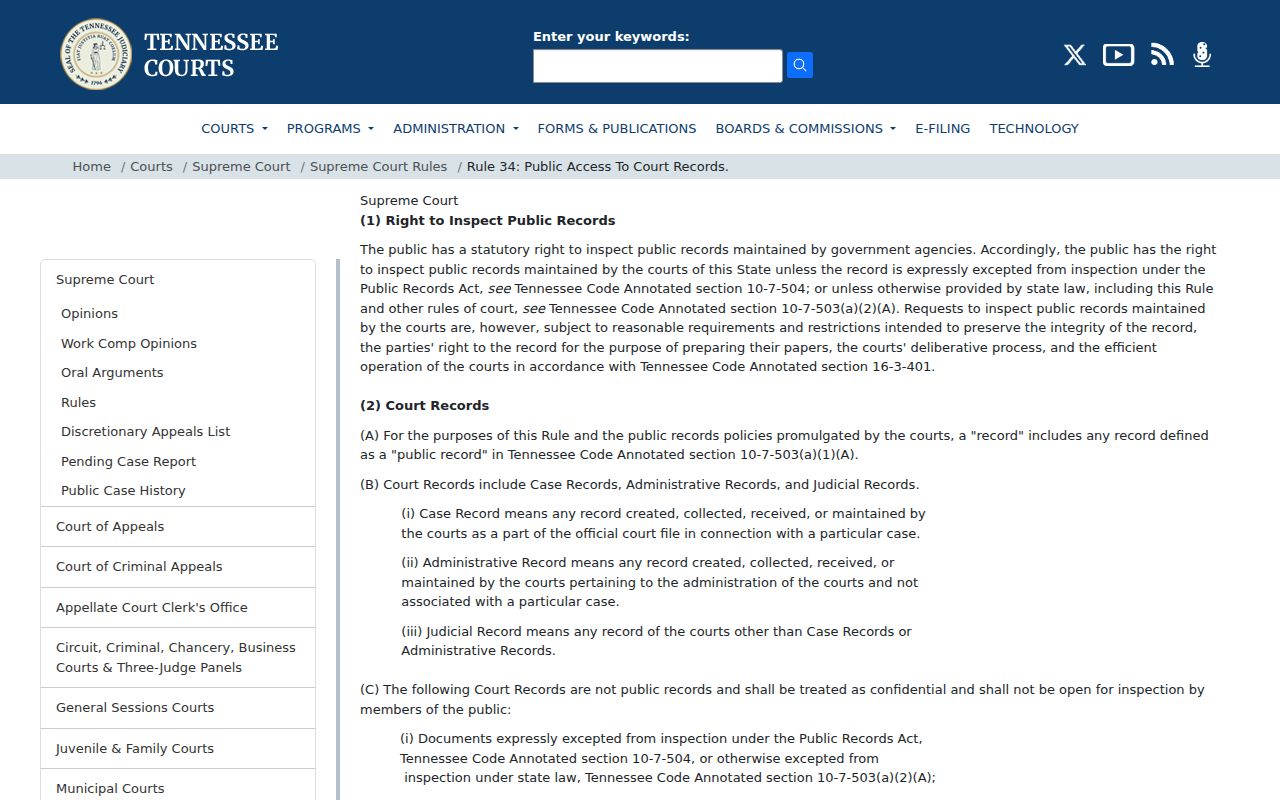
The court and its custodian make the access decisions. If a request is denied, ask for the cited basis and follow the review route the office provides.